Tile and grout calculator
+ 1 × 10 lb grout bag
144 sq ft to tile · 12 × 12 in tiles · straight · 141 tiles before waste, plus 15% for cuts
Your layout, drawn to the tile's size
- Whole tile
- Cut tile
- Joint (grout)
The area is 12 × 12 ft. Tiles are drawn at their real proportions with the joint between them.
Waste by layout
| Layout | Waste | Tiles | Boxes |
|---|---|---|---|
| Straight | 15% | 163 | 17 |
| Diagonal | 20% | 170 | 17 |
| Herringbone | 20% | 170 | 17 |
Straight (15%) and herringbone (20%) allowances: Fireclay Tile, How a little extra can go a long way, checked 2026-11-27.
Diagonal uses 20%, our own planning figure set equal to herringbone. Every layout is counted for the same area and tile.
Grout, by the maker's formula
kg per m² = (A + B) ÷ (A × B) × C × D × K
A and B are the tile's length and width, C its thickness and D the joint, all in millimetres. K is the grout's density factor.
With A = 304.8, B = 304.8, C = 9.5, D = 3.2 and K = 1.6: 0.32 kg per m², so 9.4 lb of grout, which is 1 × 10 lb bag.
K = 1.6 for MAPEI Ultracolor Plus, from MAPEI, Selection Chart of Grouts and Flexible Joints, checked 2026-11-27.
A 12 × 12 ft floor with 12 × 12 in tiles, a 1/8 in joint and a straight layout needs 163 tiles (17 boxes of 10) and one 10 lb bag of grout, with 15% added for cuts.
How tiles are counted
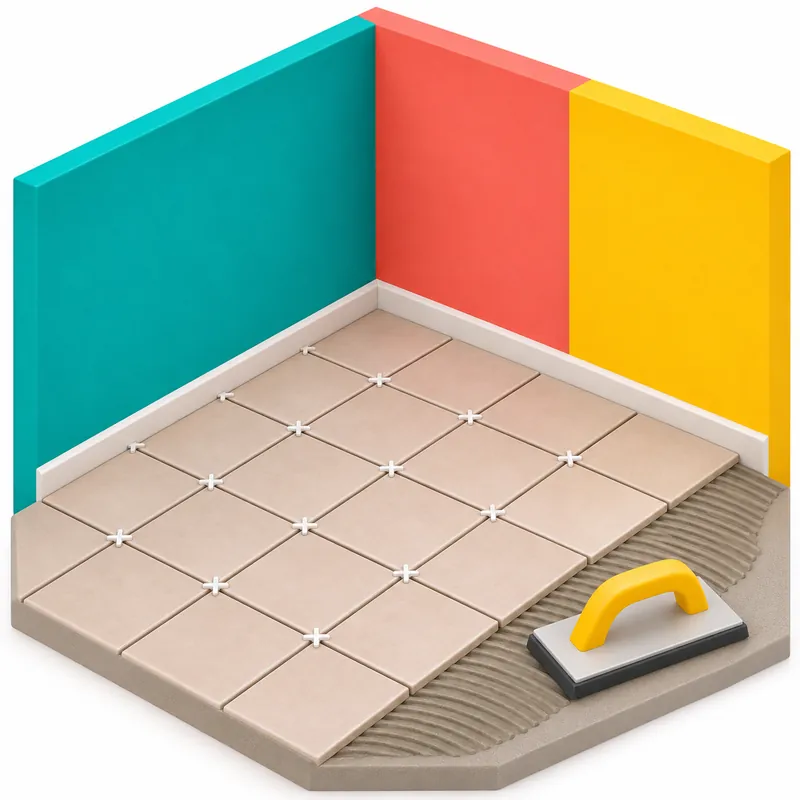
The area is divided by the size of one tile plus its joint, then the waste share of the layout is added and the total rounds up. A 12 in tile with a 1/8 in joint takes 12.125 in each way, so 144 sq ft holds about 141 tiles. Adding 15% for cuts gives 163, which is 17 boxes of 10. The tiles in a box are printed on the box, so type the number from yours.
Waste by layout
A straight layout needs about 15% extra and herringbone about 20%, the figures Fireclay Tile gives for field tile and for patterns like herringbone. We use 20% for diagonal too, as our own planning figure. The table counts each layout for the same area: 163 tiles straight, 170 diagonal and 170 herringbone, which is 17 boxes in all three here. The drawing shows why: a diagonal layout cuts a tile along every wall.
Grout by the maker's formula
Grout uses the grout maker's formula, kg per m² = (A + B) ÷ (A × B) × C × D × K. A and B are the tile's sides, C its thickness and D the joint, all in millimetres, and K is 1.6 for MAPEI Ultracolor Plus. For the example that is 0.32 kg per m², or 9.4 lb over the floor, so one 10 lb bag. A wider joint or a thicker tile raises it in proportion, so check the thickness printed on your tile box.
Questions
How much extra tile should I buy?
It depends on the layout: 15% for a straight layout and 20% for diagonal or herringbone in our plan. A room with many corners and cut-outs can use more, so add to the area rather than guess.
Can I use this for a wall?
Yes. Switch “Area to tile” to a wall or other area and type its length and height. Doors and windows are not taken out, so enter each tiled part, or accept the few extra tiles.
How much grout do I need for 144 sq ft?
With 12 × 12 in tiles, a 1/8 in joint and 3/8 in thickness it is 9.4 lb, which is one 10 lb bag. A smaller tile means more joints and more grout.